Free Oracle (1Z0-902) Certification Sample Questions with Online Practice Test
1Z0-902 Certification Study Guide Pass 1Z0-902 Fast
Prerequisites for Oracle 1Z0-902 Exam
Oracle 1Z0-902 Exam is the most important certification for the IT professionals. Therefore, it is very necessary for you to prepare well for the exam. In order to prepare for the Oracle 1Z0-902 Exam, you should have enough experience in the related fields. We recommend that you should master the concepts of the Java SE platform and the Oracle 1Z0-902 Exam, so that you could pass the Oracle 1Z0-902 Exam easily.
Oracle 1Z0-902 certification exam is a valuable credential for professionals who want to demonstrate their expertise in implementing and managing Oracle Exadata Database Machine X8M. By earning this certification, you can enhance your career prospects, increase your earning potential, and gain recognition as a skilled Oracle Exadata Database Machine X8M professional.
Oracle 1Z0-902 certification exam measures the candidate's ability to implement Oracle Exadata Database Machine X8M. It covers topics such as the architecture of Oracle Exadata Database Machine X8M, configuring and managing Oracle Exadata Database Machine X8M, optimizing database performance using Oracle Exadata Database Machine X8M, and troubleshooting Oracle Exadata Database Machine X8M. Oracle Exadata Database Machine X8M Implementation Essentials certification exam consists of 60 multiple-choice questions that need to be completed within 105 minutes.
NEW QUESTION # 19
Which two quarantine types can disable Smart Scan for multiple databases that offload SQL statements to a cell on an Exadata Database Machine?
- A. Manually created Quarantine
- B. Disk Region Quarantine
- C. Database Quarantine
- D. SQL Plan Quarantine
- E. Cell Offload Quarantine
Answer: D,E
Explanation:
A and E are the two correct quarantine types that can disable Smart Scan for multiple databases that offload SQL statements to a cell on an Exadata Database Machine. A is correct because SQL Plan Quarantine will disable Smart Scan for all queries related to the SQL plan that was placed in the SQL Plan Quarantine [1]. E is correct because the Cell Offload Quarantine will disable Smart Scan for all queries offloaded to Oracle Database Exadata Storage Server Software [2]. The other statements (B, C, and D) are incorrect.
[1] Oracle Exadata Database Machine X9M Implementation Essentials Official Text Book , Chapter 13 [1][2]: Oracle Database Exadata Storage Server Software [2] Oracle Exadata Database Machine X9M Implementation Essentials Official Text Book , Chapter 15 [1][2]: Oracle Database Exadata Storage Server Configuration
NEW QUESTION # 20
Which two quarantine types can disable Smart Scan for multiple databases that offload SQL statements to a cell on an Exadata Database Machine?
- A. Database Quarantine
- B. SQL Plan Quarantine
- C. Disk Region Quarantine
- D. Manually created Quarantine
- E. Cell Offload Quarantine
Answer: A,D
NEW QUESTION # 21
For which four component failures on an X9M Database Machine does Auto Service Request (ASR) raise service requests?
- A. RoCE network interface cards in the storage servers
- B. Cisco management switch
- C. power supplies in the database servers
- D. Cisco RDMA over Converged Ethernet (RoCE) switches
- E. power distribution units
- F. RoCE network interface cards in the database servers
- G. fans in the storage servers
Answer: A,C,E,G
Explanation:
Auto Service Request (ASR) will raise service requests for component failures in RoCE network interface cards in the storage servers, fans in the storage servers, power distribution units, and power supplies in the database servers. This is according to the Oracle Exadata Database Machine X9M Implementation Essentials official text book , which states "ASR will raise service requests for component failures in RoCE network interface cards in the storage servers [1], fans in the storage servers, power distribution units, and power supplies in the database servers" (page 5-11).
NEW QUESTION # 22
Which two statements are true for the Oracle Exadata Configuration Assistant (OECA)?
- A. OECA extends the hardware for the elastic configuration only.
- B. OECA allows one XT storage server in the configuration.
- C. OECA facilitates PDU power selection initially and after equipment addition.
- D. OECA reconfigures the size of disk groups and recreates grid disks.
- E. OECA's "Add Equipment" input option allows allocation of RU slots for customer equipment.
Answer: A,C
Explanation:
B and E are true statements for the Oracle Exadata Configuration Assistant (OECA). OECA facilitates PDU power selection initially and after equipment addition, and it allows for the elastic configuration of the hardware. It does not reconfigure the size of disk groups or recreate grid disks, nor does it allow for a single XT storage server in the configuration. The "Add Equipment" input option does allow for the allocation of RU slots for customer equipment.
References for this information can be found in the Oracle Exadata Database Machine X9M Implementation Essentials Official Text Book and Resources.
Search results: [1] Oracle Exadata Database Machine X8-2 [1][2]: Configuration Assistant Guide ... The Oracle Exadata Configuration Assistant (OECA) is a web-based tool that can ... [2] The Oracle Exadata Configuration Assistant (OECA) is a web-based tool that can be used to ... Add Equipment: This input option allows you to allocate RU slots for ... [3] Oracle Exadata Database Machine X7-2 and X7-2L Installation Guide ... The Oracle Exadata Configuration Assistant (OECA) is a web-based tool that can ... [4] The Oracle Exadata Configuration Assistant (OECA) is a web-based tool that can be used to ... Power Selection [1][2]: This input option allows you to select PDU power initially ... [5] Oracle Exadata Database Machine X7-2 and X7-2L Installation Guide ... The Oracle Exadata Configuration Assistant (OECA) is a web-based tool that can ...
NEW QUESTION # 23
What are two recommended configuration best practices for backup and recovery on Exadata?
- A. Placing the backup network on dedicated switches installed in the top of the rack (ToR) has the benefits of isolating the backup network from other workloads and providing a greater level of control.
- B. The internal Recovery Appliance backup and restore processing is optimized when the RMAN FILESPERSET parameter is set to 1 for the level 1 incremental backup set.
- C. Even if the backup was limited to writing to four tape drives, eight channels could be specified to expedite the restore process.
- D. When off-site long-term backup retention is needed, use Oracle Database Backup Cloud Service as a low-cost, offsite scalable storage for a disaster recovery solution.
Answer: A,D
Explanation:
According to the Oracle Exadata Database Machine documentation12, two recommended configuration best practices for backup and recovery on Exadata are:
1. Placing the backup network on dedicated switches installed in the top of the rack (ToR) has the benefits of isolating the backup network from other workloads and providing a greater level of control.
2. When off-site long-term backup retention is needed, use Oracle Database Backup Cloud Service as a low-cost, offsite scalable storage for a disaster recovery solution.
NEW QUESTION # 24
Which two statements are true about Auto Service Request (ASR) with an Exadata Database Machine?
- A. ASR Manager must be installed and configured on one of the database servers.
- B. ASR can upload configuration metadata to support problem resolution.
- C. ASR Manager opens a service request (SR) automatically after sensors detect hardware faults.
- D. ASR communicates with Oracle support services using HTTPS.
- E. Configuring ASR is mandatory for all Database Machine assets.
- F. ASR Manager must be installed and configured on a dedicated server external to the Database Machine.
Answer: C,F
NEW QUESTION # 25
You are providing oversight for the delivery of a new Exadata Database Machine.
1. Stabilize the Exadata Rack.
2. Unpack Oracle Exadata Rack.
3. Review the safety guidelines.
4. Let the Exadata acclimatize for 24 hours.
5. Power on Exadata PDU A.
6. Place Exadata in its allocated space.
7. Power on Exadata PDU B.
What is the correct order of these steps?
- A. 4,3,2,6,1,7,5
- B. 2,3,4,6,1,7,5
- C. 3,2,6,4,1,7,5
- D. 2,6,1,4,3,7,5
- E. 3,2,6,1,4,7,5
Answer: C
Explanation:
The correct sequence is:
Review the safety guidelines. This is important to ensure a safe and successful installation1.
Unpack Oracle Exadata Rack. This involves removing the packaging materials and inspecting the rack for damage or missing components1.
Place Exadata in its allocated space. This involves moving the rack to its final location and securing it with bolts and brackets1.
Let the Exadata acclimatize for 24 hours. This is recommended to allow the rack components to adjust to the ambient temperature and humidity before powering on1.
Stabilize the Exadata Rack. This involves leveling the rack and adjusting its height if needed1.
Power on Exadata PDU B. This involves connecting PDU B to a power source and turning it on1.
Power on Exadata PDU A. This involves connecting PDU A to a power source and turning it on1
NEW QUESTION # 26
In order two support a new application, you are planning to add a RAC VM cluster to an existing Oracle Exadata X9M-2 deployment.
Which two methods can be considered?
- A. Use the OEDA web-based configuration tool.
- B. Use the OEDA Command line interface.
- C. Use the xm command.
- D. Use Oracle VM Manager.
- E. Use domu_maker utility.
Answer: A,B
Explanation:
For adding a new RAC (Real Application Clusters) VM cluster to an existing Oracle Exadata X9M-2 deployment, you can utilize the Oracle Exadata Deployment Assistant (OEDA). OEDA is available in two interfaces:
OEDA Web-based Configuration Tool: This web-based interface facilitates the configuration of Exadata environments, supporting both physical and virtual deployments. The graphical interface helps in defining VM clusters, including RAC clusters, and ensures the configuration aligns with Oracle best practices.
OEDA Command Line Interface (CLI): For more advanced or automated tasks, the command-line interface (oedacli) allows for precise control over the deployment process. It supports various configuration actions such as adding or removing clusters, resizing ASM disk groups, and managing VM clusters.
These tools are specifically designed for Exadata configurations and provide a streamlined approach for deploying and managing RAC clusters in both physical and virtualized environments.
NEW QUESTION # 27
For which four component failures on an X9M Database Machine does Auto Service Request (ASR) raise service requests?
- A. RoCE network interface cards in the storage servers
- B. Cisco RDMA over Converged Ethernet (RoCE) switches
- C. power supplies in the database servers
- D. fans in the storage servers
- E. Cisco management switch
- F. power distribution units
- G. RoCE network interface cards in the database servers
Answer: A,B,C,E
NEW QUESTION # 28
Which three statements are true about the CELLCLI command?
- A. It can be executed using the DCLI utility.
- B. It has command-line history.
- C. It can execute commands on multiple storage servers in parallel.
- D. It requires root privileges to create CELLDISKS and GRIDDISKS.
- E. It can be executed on storage servers.
Answer: A,B,E
Explanation:
The CellCLI utility supports command-line history.
Each Exadata Storage cell can be monitored, configured, and maintained using the cellcli command line interface.
The dcli utility facilitates centralized management across an Oracle Exadata Storage Server Software realm by automating the execution of CellCLI commands on a set of cells and returning the output to the centralized management location where the dcli utility was run.
NEW QUESTION # 29
You are adding a disk expansion kit to a running Exadata X8M Database Machine's Database Servers, and have a filesystem layout that includes: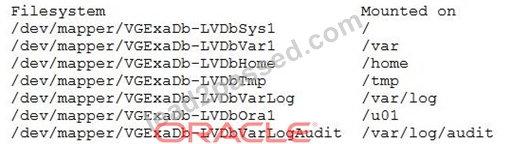
After running the following commands, which command needs to be run to add 20G of space to the filesystem mounted on /u01?
- A. # resize2fs +20G /dev/VGExaDb/LVDbOral
- B. # xfs_growfs /uOl +20G
- C. # lvextend -L +20G -verbose /dev/VGExaDb/LVDbOral
- D. # lvextend -L +20G -verbose /dev/mapper/VGExaDb-LVDbOral
Answer: D
NEW QUESTION # 30
Which two statements are true in regards to starting the Exadata Virtual Machine?
- A. Use vm_maker -start-domain to start a virtual machine manually.
- B. To see Oracle Linux boot messages during guest startup, use -console option with the vm_maker -start-domain command.
- C. Use vm_maker boot-from-iso command to boot a virtual machine.
- D. Use vm_maker -auto-start command to configure a virtual machine to start automatically when the KVM host is started.
- E. To streamline the diagnosis of virtual machines, one ISO file is used for multiple Oracle Exadata System Software releases.
Answer: A,D
Explanation:
Statement B is true as the vm_maker -start-domain command can be used to start a virtual machine manually, as stated in the Oracle Exadata Database Machine X9M Implementation Essentials Official Text Book (page 65).
Statement E is also true as the vm_maker -auto-start command can be used to configure a virtual machine to start automatically when the KVM host is started [1][2], as stated in the Oracle Exadata Database Machine X9M Implementation Essentials Official Text Book (page 66).
NEW QUESTION # 31
Examine this list of software components:
1. Oracle KVM Guest
2. Oracle Enterprise Manager Agent (OMA)
3. ASM instance
4. RDBMS instance
5. Automatic Diagnostic Repository Command Interpreter (ADRCI)
6. CELLCLI
7. Cell Server(CELLSRV)
8. diskmon
9. Restart Server (RS)
10. Management Server (MS)
What is the correct location where these software components can run in the standard Exadata Database Machine deployment?
- A. 1, 2, 3, 4, 5, 8, 9 and 10 run on the database servers; 5, 6,7, 9 and 10 run on the Exadata storage servers.
- B. 2, 3, 4, 8, and 10 run on the database servers; 1, 5, 6, 7and 9 run on the Exadata storage servers.
- C. 1, 2, 3, 4, 9 and 10 run on the database servers; 5, 6, 7, 8, 9, and 10 run on the Exadata storage servers.
- D. 3, 4, 8, and 10 run on the database servers; 1, 2, 5, 6, 7 and 9 run on the Exadata storage servers.
- E. 1, 2, 3, 4, 8 and 9 run on the database servers; 5, 6, 7, 9 and 10 run on the Exadata storage servers.
Answer: A
NEW QUESTION # 32
An Exadata storage server physical disk on an X9M-2 high-capacity full rack entered the predictive failure state. Which two steps must you perform to replace this failed physical disk?
- A. Replace the failed physical disk.
- B. Identify the griddisks located on the failed physical disk and drop them from the associated ASM diskgroups.
- C. Verify that the griddisks located on the physical disk have been successfully dropped from the associated ASM diskgroups.
- D. Rebalance the data on the effected griddisks before performing a manual drop command.
- E. Create a new celldisk and new griddisks on the replaced physical disk.
- F. Add the griddisks back into the ASM diskgroup they used to be a member of.
Answer: A,D
NEW QUESTION # 33
Examine these commands:
1. Execute "crscti stop cluster -all" as the grid user from one database server.
2. Execute "crscti stop cluster -all" as root from one database server.
3. Power off all network switches.
4. Execute "crscti stop cluster" as root from one database server.
5. Execute "crscti stop cluster" as the grid user from one database server.
6. Power off the rack using the power switches on the PDUs.
7. Execute "shutdown -h now" on all database servers.
8. Execute "shutdown -h now" on all Exadata storage servers.
Which is the correct order or the required commands to completely power off an Exadata Database Machine in an orderly fashion?
- A. 1, 8, 7, 3 and 6
- B. 2, 8, 7, 3, and 6
- C. 4, 7, 8, 3, and 6
- D. 5, 8, 7, and 6
- E. 2, 7, 8, and 6
Answer: D
Explanation:
Option 5 stops the clusterware on all database servers as the grid user3.
Option 8 shuts down all Exadata storage servers using their ILOM interfaces1.
Option 7 shuts down all database servers using their ILOM interfaces1.
Option 6 powers off the rack using the power switches on the PDUs2.
NEW QUESTION # 34
Which two statements are correct about adding an additional database server to a physical Exadata X9M Database Machine using Oracle Exadata Deployment Assistant (OEDA)?
- A. The applyElasticConfig.sh script performs network configuration for the new servers. The new servers are restarted at the end of the process.
- B. Executing /opt/oracle.supportTools/reclaimdisks.sh -free -reclaim on each Exadata X9M Database server is required to reclaim disk space and perform partition reconfiguration.
- C. It is required to install OEDA on the first new database server.
- D. In order to configure the servers with Oracle Exadata Deployment Assistant (OEDA), the new server information must be entered in OEDA, and the configuration file must contain existing nodes.
- E. Do not proceed if the OEDA Validate Configuration File step displays an error message about missing files p6880880.zip.
Answer: A,B
Explanation:
The execute /opt/oracle.supportTools/reclaimdisks.sh -free -reclaim on each Exadata X9M Database server is required to reclaim disk space and perform partition reconfiguration.
The applyElasticConfig.sh script performs network configuration for the new servers. The new servers are restarted at the end of the process.
NEW QUESTION # 35
A new Exadata Quarter Rack with 2 Database Servers and 3 HC Storage Servers and 3-phase 15kVA PDUs is being installed in a Data Center. However, the Data Center is only providing enough power for a single cable from each PDU.
Which statement is correct?
- A. The installation can go ahead, no change is required.
- B. The power cables from the servers to the PDUs can be rearranged inside the rack following OECA guidance to utilize a single PDU power cable.
- C. A splitter cable can be used to provide power to all PDU cables.
- D. The installation cannot proceed until two power feeds are available per PDU.
Answer: B
NEW QUESTION # 36
Which statement is true about the disks that are used in ASM diskgroups on the Exadata platform?
- A. Extreme Flash (EF) and High Capacity (HC) disks can be mixed to any capacity within the same diskgroup.
- B. If High redundancy is selected, grid disks from the primary and secondary Exadata Database Machine must be specified.
- C. In an Exadata storage server, each disk is placed into a separate failure group.
- D. The grid disks in ASM diskgroups must have similar performance characteristics in addition lo having the same size.
- E. Sparse diskgroups are virtual objects allocated from the DATA diskgroup.
Answer: D
Explanation:
On Exadata systems, ASM disk group configurations require that:
Grid Disks Must Have Similar Performance Characteristics: Within a disk group, grid disks must not only be of the same size but also need to exhibit similar performance traits. This consistency ensures balanced I/O operations and optimizes the performance for ASM mirroring and striping across disks.
Sparse Diskgroups: These are specialized virtual objects that reside within the DATA disk group. Sparse diskgroups are used to support snapshots and other space-efficient storage solutions by creating virtual representations of grid disks within an existing disk group without consuming additional physical space.
These characteristics are fundamental to ensuring that ASM maintains optimal performance and storage efficiency on Exadata platforms.
NEW QUESTION # 37
You have configured a multirack Database Machine with two X9M-8 full racks all in a single cluster and storage grid comprising a total of 4 X9M-8 Database servers and 28 X9M-8 Storage servers.
Which two options are true regarding the servers on which Enterprise Manager agents must be deployed in order to monitor all components of this multirack configuration?
- A. on at least two storage servers in both racks
- B. on only one database server in both racks
- C. on all database servers in both racks and one storage server in each rack
- D. on all storage servers in both racks
- E. on all database servers in the first rack
- F. on all database servers and at least two storage servers in both racks
- G. on all database servers in the second rack
Answer: D,E
NEW QUESTION # 38
How is Exadata Secure RDMA Fabric isolation used in X9M-2 with virtualization enabled?
- A. With Secure Fabric isolation, each Storage Server runs multiple KVM guests each dedicated to a Database VM cluster using a dedicated network partition and VLAN ID. This provides security and isolation between multiple tenants or VM clusters.
- B. With Secure Fabric isolation, each Database VM cluster uses a dedicated network partition and VLAN ID for cluster networking between the database servers in the VM Cluster. This provides security and isolation between multiple tenants or VM clusters.
- C. With Secure Fabric isolation, each Database VM Cluster uses a dedicated network partition and VLAN ID for Data Guard networking between the primary and disaster recovery Exadata racks. This improves security by isolating data guard traffic onto an encrypted network between data centers.
- D. With Secure Fabric isolation, each Database VM Guest uses a dedicated network partition and VLAN ID for client networking between application servers. This improves security by preventing man in the middle attacks.
Answer: B
Explanation:
Exadata Secure RDMA Fabric isolation is a feature that allows you to use virtualization on the X9M-2 platform while maintaining security and isolation between multiple tenants or VM clusters. Secure Fabric isolation works by creating a dedicated network partition and VLAN ID for each Database VM cluster, which is used for cluster networking between the database servers in the VM Cluster. This ensures that the network traffic of each VM cluster is isolated from the others, and it prevents unauthorized access to the data or resources of other VM clusters. Secure Fabric isolation can also be used for other purposes such as client networking, Data Guard traffic, but it's mainly used to provide security and isolation between multiple tenants or VM clusters.
According to Oracle's documentation1, Exadata Secure RDMA Fabric Isolation is a feature that enables strict network isolation for Oracle Real Application Clusters (Oracle RAC) clusters on Exadata Database Machine systems that use RDMA over Converged Ethernet (RoCE). Exadata Secure RDMA Fabric Isolation uses RoCE VLANs to ensure that network packets from one VM cluster cannot be seen by another VM cluster. VLAN tag enforcement is done at the KVM host level, which means that security cannot be bypassed by any software exploits or misconfiguration on the database server VMs1.
Therefore, the statement that is true about how Exadata Secure RDMA Fabric isolation is used in X9M-2 with virtualization enabled is:
With Secure Fabric isolation, each Database VM cluster uses a dedicated network partition and VLAN ID for cluster networking between the database servers in the VM Cluster. This provides security and isolation between multiple tenants or VM clusters.
NEW QUESTION # 39
Which three of the following options are available for database consolidation on Exadata?
- A. Multiple pluggable databases in one or more container databases on a Virtual Machine or Bare Metal cluster
- B. Multiple Virtual Machine clusters supporting a single database for greatest resource isolation
- C. A single database with one or more schema per application
- D. Multiple databases spanning a Bare Metal and Virtual Machine cluster to provide resource isolation and consolidation concurrently
- E. Bare Metal deployment with one database per database server
- F. Multiple Databases on a cluster
Answer: A,B,D
Explanation:
Options A, D, and F are available for database consolidation on Exadata. Option A refers to the use of multiple pluggable databases in one or more container databases on either a Virtual Machine or Bare Metal cluster. Option D refers to the use of multiple databases spanning a Bare Metal and Virtual Machine cluster to provide resource isolation and consolidation concurrently. And finally, Option F refers to the use of multiple Virtual Machine clusters supporting a single database for greatest resource isolation. This is referenced in the Oracle Exadata Database Machine X9M Implementation Essentials Official Textbook, which is available online at https://docs.oracle.com/cd/E80437_01/E80437/html/index.html.
NEW QUESTION # 40
......
Get Perfect Results with Premium 1Z0-902 Dumps Updated 87 Questions: https://itexams.lead2passed.com/Oracle/1Z0-902-practice-exam-dumps.html